What is this bird with a long white tail?


The Question: A seabird showed up every day to circle our sailboat 200-300 miles northeast of the Bahamas. One day there were 3 of them, but most days there was just one. It looked ‘gull-like’ and was very white with striking black trim around the trailing edge of his wing feathers. The tail is long and string-like in appearance (versus a fan of feathers). What bird is this?

Submitted by: Ed, NC


The Short Answer: Ed, your photos and description are perfect for a tropicbird. The long trailing tail is a giveaway. From your photo and the locality, I would guess that what you saw is a White-tailed Tropicbird (Phaethon lepturus), the smallest of the world’s three tropicbirds, with a wingspan of about three feet (94 cm). The other possibility would be the Red-billed Tropicbird (Phaethon aethereus), which is a bit larger, with a wingspan of 44 inches (112 cm). The Red-billed Tropicbird flies with shallow wingbeats and even at some height, the red bill is fairly visible. So unless you saw either of those clues, I feel pretty comfortable identifying your birds as White-tailed Tropicbirds.

More Info: The White-tailed Tropicbird spends most of its life flying over the ocean, eating fish and squid off the surface. Their best trick is catching flying fish on the wing … or on the fin, to be more accurate. The White-tailed Tropicbird is found throughout the tropical oceans of the world.

Share:
  • Digg
  • Facebook
  • Twitter
  • Google Bookmarks
  • RSS
  • del.icio.us
  • Reddit
Print Friendly Print Friendly

My Encounter With Beavers

I spend most of the summer on a small lake in central Massachusetts. The lake empties through a culvert under a road and into a large marsh through which the water flows. The marsh goes under a footbridge, and around a couple of corners and eventually spills over a large beaver dam. That there are beavers active in the area is clear. Last fall, the trees right in front of my house were chewed, though not felled, by a beaver.

Last week, I bought a small, inflatable kayak, specifically so that I could paddle it across the lake to the road, carry it over the road and then continue on into the marsh. Two days after I bought the kayak, I was up early and decided to try I out. As I made my way through the marsh, I passed a beaver lodge. Just as I came up on it, I heard a slap on the water and saw a big splash. Slapping the water with the flat of their tail is a common beaver behavior. It makes a loud noise that is quite effective in its presumed intent to startle. While a potential predator recovers from the surprise, the beaver escapes in the water.

I never actually saw the beaver. I just heard the splash and saw the ripples left behind. As I moved a little further along in the marsh, I saw a beaver coming towards me. Whether the same or another beaver, I’m not sure. The beaver was swimming, as they do, with just its head exposed in the water, and it was carrying something. At first I thought it was carrying sticks, but I got out the binoculars to take a closer look and realized it was carrying a baby beaver, or kit, as they are called. When I first saw it, the beaver was maybe 50 or 60 feet away (15-18 meters), headed directly at me, and I sat still in the water in my bright yellow inflatable kayak. The beaver continued to get closer and closer with the limp baby in its mouth. As it grew really close, I began to get concerned as to what exactly its intentions were as I sat there in blow-up vinyl boat. Finally, when the beaver was about five or six feet away, mother beaver apparently noticed for the first time that there was a person in the yellow inflatable kayak in her way and, startled, she dove under the water … leaving her baby floating five feet from the kayak.

The kit at that point came out of its limp stupor and began swimming … right at my bright yellow kayak. So I paddled backwards a bit. The kit kept coming at me. I paddled back a bit more. The kit kept coming. Finally, I paddled back about thirty feet away, at which point the kit lost interest in me and began swimming in a big circle, making soft whimpering noises. I feared I had done something wrong and broken up a happy little beaver family. So I waited and hoped Mama beaver would come back to get her baby.

After watching and listening to the heartbreaking whimpers of the baby beaver for about five minutes, I began thinking, “Oh, great. I’m going to have rescue a baby beaver.” But just when I started thinking seriously about that, Mama beaver surfaced and began swimming with the baby. For a while they swam around each other, and the kit climbed on the mother’s back a couple of times. Finally, the mother took the baby in her mouth again and began to swim off. Relieved, I continued on my way through the marsh.

On the way back, however, when I came to same part of the marsh, baby beaver was again swimming around whining. At this point, I was less worried about its safety than about my ability to paddle past it without it chasing me again. So I waited for it to move off to the side, and then quickly paddled past. A little further on, I saw another adult beaver, presumably Mama again, working in some reeds. It seems she was just giving baby beaver a little taste of independence.

A quick search on the internet didn’t turn up a lot of information, but I did find a couple of references to beavers moving kits when the mother beaver feels her kits might be in danger if left behind in the lodge. So maybe there was a fox or coyote in the area that made mama beaver nervous and that’s why she took her kit to work with her. I guess she didn’t count on meeting a bright yellow kayak. And then once she realized inflatable boats didn’t pose any particular threat, she just went back to being busy.

Anyway, it was ultimately an interesting encounter, and a nice christening for my new inflatable kayak.

Share:
  • Digg
  • Facebook
  • Twitter
  • Google Bookmarks
  • RSS
  • del.icio.us
  • Reddit
Print Friendly Print Friendly

What are these tiny oily beads in Lake Huron?

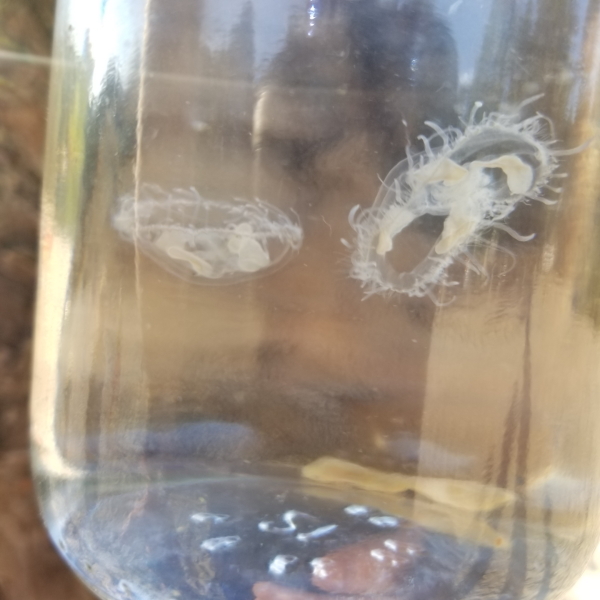
The Question: In Michigan in early July, thousands of tiny, clear, oily, bead-like things were scattered all over the beach along the water line. We were wondering if they were a natural occurrence or some kind of pollution.

Submitted by: Sara, MI

(The picture to the left was taken with a cell phone.)

The Short Answer: Both of the Lake Huron experts I contacted suggested that what you saw was Holopedium gibberum, a tiny cladoceran crustacean. Cladocerans, which include other small aquatic animals like daphnia, are part of the zooplankton of lakes and ponds. Like most cladocerans, Holopedium reproduces in two ways. Throughout the summer, females reproduce asexually through parthenogenesis, which means that females lay unfertilized eggs which hatch into more females – no males needed. In Holopedium, the developing eggs are carried in a brood pouch on the back of the female. This brood pouch can be twice as long as the female and looks like a gelatinous fish egg. When the density of Holopedium is high, they can wash up on beaches and look like what Sara saw on the shores of Lake Huron. Towards the end of the summer or early fall, some of the offspring will be male and sexual reproduction occurs. The result of this is fertilized “resting” eggs that survive the winter on the bottom of the lake. When these eggs hatch in the spring, they start the cycle over again.

The Environmental Issue:

While seeing Holopedium on the shore isn’t the result of pollution, as Sara feared, it’s probably not a good thing. Jim Johnson, Research Biologist/Manager at the Michigan Department of Natural Resources & Environment Alpena Fishery Research Station, explains:

“Holopedium has recently become more dominant in Lake Huron during late summer and their increase corresponds with changes wrought to the ecosystem by dreissenid mussels (zebra and quagga mussels) that invaded Lake Huron from the Caspian Sea region. The mussels got here via ballast water from ocean going ships. Evidently, the mussels have deprived Lake Huron of nutrients by filtering the lake of food and tying up nutrients in the mussel colonies on the lake bottom. Holopedium is a native zooplankton. It somehow manages to make a living in relatively sterile waters such as Lake Superior and, now, in Lake Huron. An abundance of holopedium is an indication that the water is exceptionally sterile (not very productive).”

Jim suggests that for more information, you can go to his office’s web page:

http://www.michigan.gov/dnr/0,1607,7-153-10364_52259_10951_11244—,00.html

At the following site, you can watch a trailer for a video about invasive species in Lake Huron:

http://www.lakeinvaders.com/Lake_Invaders.html

The Interesting Science: Animals like Holopedium that alternate between sexual reproduction and asexual reproduction are interesting test cases for hypotheses about the evolution of sex. An animal that reproduces asexually can essentially reproduce twice as fast as a sexually reproducing species. It seems that this would lead to a huge disadvantage for animals that reproduce sexually, and in the short term this seems to be true. However, scientists hypothesize that in the long term, animals that reproduce asexually can’t adapt as rapidly as sexually reproducing species because the offspring of an animal reproducing asexually are identical clones of the parent. The only variation would be a result of mutation. The offspring of animals reproducing sexually are a mixture of the genetic material of both parents, resulting in new combinations in every generation. Because there is so much more variety in the sexually reproducing species, some members will be more able to survive changes in the environment, new diseases, etc. Over time, it seems that the sexually reproducing lineage would be more likely to persist. This might explain why, although asexually reproducing species can multiply twice as fast as sexually reproducing species, the world is mostly filled with sexual reproducers. In fact, aside from some unusual rotifers, all the known parthenogenic species are relatively young in evolutionary terms. It seems that they just can’t last over the long run.

As for animals like Holpedium and other cladocerans, they seem to have figured out how to have the best of both worlds. In the spring and through the summer, their populations can grow rapidly through asexual, parthenogenic reproduction. But when fall comes, their thoughts turn to love, and they begin to reproduce sexually, mixing up their genes and creating new combinations ready to compete in the spring.

For more information on Holopedium, check out this site at Central Michigan University:

http://www.cst.cmich.edu/users/mcnau1as/zooplankton%20web/holopedium/holopedium.html

Share:
  • Digg
  • Facebook
  • Twitter
  • Google Bookmarks
  • RSS
  • del.icio.us
  • Reddit
Print Friendly Print Friendly

What is This Eel-like Fish?

The Question: I recently I saw an eel-like fish while swimming in the sea in Rockport, MA. It looked around 3 feet (1 meter) long and was white/grey with black stripes (running from nose to tail, not vertically). It moved like an eel. We were in water that was around 3 feet (1 meter) deep, no snorkeling/diving mask.  It was very sandy, no rocks at all.  Not sure how many stripes exactly – my impression was that it was black stripes on a silver/white body…perhaps 12 or so thin stripes running nose to tail.  We saw it three times (or maybe different individuals). I would love to know what it was.

Submitted by: Kathryn W., Massachusetts

The Short Answer: I thought at first Kathryn might have seen an American eel (Anguilla rostrata), but the description of stripes bothered me. I asked two fisheries biologists who both came back with the same answer: striped bass (Morone saxatilis). When I asked Kathryn how tall the fish was, she said it was more like six inches (15 cm) than three inches (7.5 cm), which pretty much clinched it. That measurement suggests much more of a striped bass shape than the thin shape of an American eel.

Ken Oliviera, associate professor of biology at the University of Massachusetts Dartmouth, and an expert on American eels, said he has never seen a striped pattern on an American eel, and the location suggests striped bass to him. He also said it was probably multiple fish, since striped bass school.

Brad Chase, aquatic biologist for the Massachusetts Division of Marine Fisheries, was also bothered by the stripes. He pointed out that American eels are typically nocturnal and they prefer habitat with rocks and other hiding places. His guess agreed with that of Ken Oliviera in that the size, stripes, and location point to striped bass.

So I think that’s your mystery fish, a school of striped bass.

The Interesting Science: It just so happens that striped bass and American eel have something in common. They both breed in one type of water and live in another. Striped bass are “anadromous” which means they breed in fresh water, but spend most of their lives in salt water. Salmon, of course, are famous for this, but they are hardly the only fish that goes up rivers to breed and then moves into the ocean to grow. The American eel, however, is “catadromous” which means it breeds in salt water, and then moves to fresh water. This is a far less common lifestyle. For a long time the breeding location of the American eel was unknown. But we now know they breed in the Sargasso Sea, an area of relative calm in the Atlantic Ocean. Once they reach about 2.5 inches (6 cm), young American eels are carried by the Gulf Stream to the Atlantic shore. It was once thought that all American eels then return to fresh water, but we now know that it’s mostly females that move into fresh water and only when conditions are good. Once the eels reach a certain size, they move back to salt water. When they reach adult size, they return to the Sargasso Sea to breed.

Share:
  • Digg
  • Facebook
  • Twitter
  • Google Bookmarks
  • RSS
  • del.icio.us
  • Reddit
Print Friendly Print Friendly

Caddisfly Home Decorating

I was snorkeling in shallow water in a small lake in central Massachusetts today, and saw an interesting creature. What caught my eye was that a small section of the sandy gravel on the lake bottom was moving. It scooted forward about an inch (2.5 cm) and stopped. Then it did it again. I picked it up gently and turned it over to investigate. It was about 3/4 of an inch (2 cm) long and about 1/2 an inch (1 cm) wide. It was made of grains of sand and gravel glued together. Attached underneath was a small tube. The creature who lived in the tube had withdrawn and couldn’t be seen, but I knew what it was: the larvae of one of over 4,000 species of caddisflies. Most caddisfly larvae construct houses, which they use for disguise and protection. Each species uses characteristic materials and design. The resulting shelters range from a small tube of reed or grass, to houses constructed out of sand in the shape of a snail shell. Other caddisflies actually glue tiny snail shells together. Most caddisfly larvae graze on algae and other plant material. Eventually, they leave the water and metamorphose into a somewhat moth-like adult. Caddisflies are, in fact, related to butterflies and moths. The pictures below show some of the diversity of caddisfly larvae homes. Unfortunately, none looks quite like the one I saw, and I didn’t have a camera, but a couple show homes constructed of gravel.

Caddisflies are often used in evaluating the health of streams. Most species are not tolerant of pollution or silted water, so to find a healthy collection of caddisflies in a stream is a good sign.

What I find most amazing about caddisflies is that they are able to construct such clever, effective and attractive homes with such a tiny brain. Incredible.

Share:
  • Digg
  • Facebook
  • Twitter
  • Google Bookmarks
  • RSS
  • del.icio.us
  • Reddit
Print Friendly Print Friendly